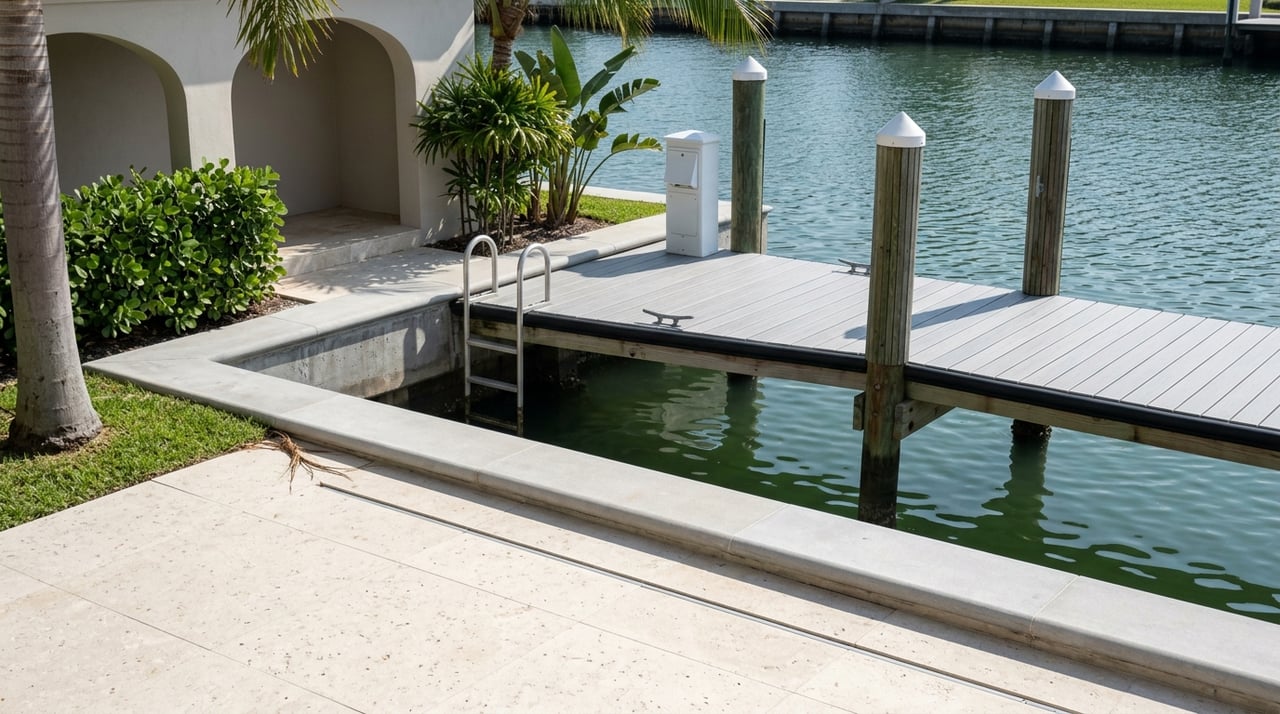
A Smarter Buyer’s Guide to Jonathan’s Landing Waterfront Homes
June 4, 2026
June 4, 2026
If you are looking for a waterfront home in Jonathan’s Landing, one detail can change everything: not all water-facing properties offer the same boating access. Some homes sit on saltwater with private dock potential, some come with deeded or leased dock options, and others offer water views without true boating convenience. If you want the right fit for your lifestyle, boat, and budget, it pays to understand the differences before you make an offer. Let’s dive in.
Jonathan’s Landing is a 606.2-acre gated residential community in unincorporated Palm Beach County, just south of Indiantown Road and west of the Intracoastal Waterway. The community blends golf, boating, and waterfront living in one established Jupiter-area setting, with photo-ID controlled gate entry.
For many buyers, the appeal is flexibility. The property owners association says golf club and marina memberships are optional, so you are not automatically buying into every amenity. That said, the club’s current contact page notes that all membership categories have a waitlist, which matters if immediate club access is part of your plan.
One of the biggest mistakes buyers make is assuming every waterfront home in Jonathan’s Landing is a boating property. The community includes a mix of saltwater, Intracoastal-oriented, freshwater, and golf-view villages, so the type of water behind the home matters just as much as the view itself.
Official village descriptions show that enclaves such as Barrow Island, Bay Head, Casseekey Island, Jonathan’s Island, Passage Island, The Harbour, Southporte, The Anchorage, and parts of Port Dickinson and Southern Cay include direct saltwater or Intracoastal exposure. Other villages may still offer attractive water views, but they may not provide the same docking or navigation opportunities.
If you plan to keep a boat behind your home, this is one of the first questions to answer. A freshwater setting may deliver scenery and privacy, but it does not automatically mean navigable boating access to the Intracoastal or inlet.
A saltwater or Intracoastal-oriented lot may be a better fit if on-the-water access is your priority. Even then, you still need to confirm actual dock rights, water depth, and route clearance for your vessel.
Dock rights can vary by home type and location. In Jonathan’s Landing, some properties have private docks, some include private deeded docks, some condo buildings have adjacent docks available for lease, and the marina offers wet slips and dry storage.
That means two homes with similar views can function very differently in real life. A waterfront condo may offer easier ownership from a maintenance standpoint, while a detached home on a dockable lot may better suit buyers who want direct private access.
In Jonathan’s Landing, dock due diligence is not optional. The community design control rules state that pier easements are recorded, and dock or lift placement must stay within those easement boundaries.
The same guidelines say any piers, mooring piles, or boat lifts require written approval from the applicable COA or HOA first, followed by DCB approval. If a seller has made changes over time, you will want to verify that the work was properly approved and permitted.
This is an important detail for buyers who expect flexibility at the dock. The community guidelines say floating docks are generally not permitted in Jonathan’s Landing’s saltwater or freshwater areas, except for certain personal watercraft or launch-style floating structures reviewed case by case.
That restriction makes the exact dock configuration especially important. If your boating setup depends on a floating system, you need to confirm whether the existing arrangement works for you before moving forward.
Boat size matters here. Historical DCB materials indicate that individually owned Casseekey Island condo docks can accommodate yachts from 40 feet to 100 feet, while the current marina operator lists 257 dry-stack slips with a 40-foot storage length limit.
In practical terms, boats over 40 feet are more likely to need a wet slip or a private dock than dry storage. That can narrow your property options quickly, especially if your vessel’s beam, draft, or lift needs are more demanding.
If you are considering dock ownership at Casseekey Island, there is another layer to understand. Community materials state that those docks were originally sold to Casseekey Island homeowners, and any resale must first be offered to Casseekey Island residents, then Jonathan’s Landing residents, and only then to non-residents.
For buyers, that means dock availability may not be as simple as seeing a unit for sale and assuming the dock can be purchased with it. You will want clear documentation on what transfers, what is separate, and what restrictions apply.
A waterfront address only tells part of the story. Your real boating experience depends on the route from your dock or marina to open water, including bridge openings, depths, and any narrow points along the way.
The marina operator says Jupiter Marina is minutes from the Jupiter Inlet, Atlantic Ocean, and Gulf Stream, and amenities include fuel, dry storage, a marine center, pump-out service, and a pool and hot tub. Community documents also say berth priority is given to Jonathan’s Landing residents, though marina access is limited to certain owners, leaseholders, club members, and invited guests.
The Town of Jupiter says the Jupiter/US1 bridge opens on demand, while the Indiantown Road bridge opens on the hour and half-hour. That schedule can affect your day-to-day use, especially if you fish early, cruise often, or want quick ocean access.
NOAA identifies electronic navigational charts as its primary nautical chart product, so buyers should verify the specific route, bridge sequence, and water depths for their boat. It is best to treat every property as its own navigation case rather than assuming all Jonathan’s Landing waterfront homes offer the same experience.
Jonathan’s Landing design documents say the community’s saltwater courses were dredged to about 5 feet. That may work for many boats, but it is not a blanket guarantee for every dock, every tide, or every season.
If your vessel has a deeper draft, verify current conditions, low-tide depth, and maneuvering room before you waive contingencies. This is one of the most important practical checks in any waterfront purchase here.
As of late May 2026, Redfin shows 22 waterfront homes for sale in Jonathan’s Landing with a median listing price of $822,000. Over the three months ending April 2026, the neighborhood’s median sale price was $809,699, down 14.3 percent year over year, with homes taking about 78 days to sell.
That data suggests buyers may have room to compare options carefully, especially if they stay focused on property function instead of just curb appeal. Still, pricing can vary widely depending on lot type, views, dock setup, building style, and monthly carrying costs.
Current visible listings illustrate the spread. Waterfront condos in Waterbend have been listed around $539,000 to $550,000, an Intracoastal-view Southporte penthouse around $999,900, and direct-water single-family homes around $2.4 million and $4.5 million.
Those examples are useful for framing the market, but they are not a fixed pricing band. In a community like Jonathan’s Landing, the premium often comes from specifics such as water frontage, dock rights, renovation level, and boating usability.
A waterfront purchase budget should go beyond the sale price. One current Southporte listing reflects $590 per square foot and HOA dues of $2,146 per month.
That does not mean every condo carries the same cost, but it is a good reminder that water-view or waterfront ownership can come with meaningful monthly expenses. Buyers should compare dues, insurance, maintenance expectations, and dock-related costs before deciding between condo and single-family options.
The right waterfront home is not just the one that looks best online. It is the one that fits your boat, your budget, and the community rules without surprises after closing.
In Jonathan’s Landing, that means paying close attention to approvals, permits, floodplain issues, and prior site work. A careful inspection period can save you from expensive mistakes.
Jonathan’s Landing guidelines state that exterior changes require HOA or COA approval first, then DCB approval. The same materials say homeowners must obtain all required state, county, and local permits, and they specifically note that bulkheads and seawalls require Palm Beach County permits and compliance with applicable rules.
The guidelines also say no dredging or excavation may occur without prior written approval and permits, and mangrove trimming is tightly controlled. If you are buying with plans to improve the dock or waterfront edge later, make sure those plans are realistic before you close.
Palm Beach County rules say no construction, including moving earth, is legal in a floodplain without a permit, and the county permit center handles building permits in the unincorporated area. Florida DEP also offers self-certification for some qualifying single-family dock projects, while more involved work may require a different permitting path through its ERP system.
FEMA states that federally backed loans in a Special Flood Hazard Area require flood insurance, and standard NFIP policies usually have a 30-day waiting period unless coverage is mandated or triggered by a map change. Before waiving contingencies, buyers should verify the FEMA flood map, property elevation, and lender and insurer requirements.
The best approach is to define your waterfront goals before you start touring. If your priority is a view and low-maintenance ownership, a condo with nearby dock access or marina use may be enough. If you want to step out to your own dock and head toward the inlet, you will need a more exact match.
It also helps to separate lifestyle wants from hard constraints. Club access may be optional, but current waitlists mean you should not assume immediate availability. Dock layout may look fine in photos, but boat length, draft, lift needs, and bridge timing can quickly turn a nice home into the wrong home.
A local, detail-focused buying strategy matters in communities like this. With the right guidance, you can narrow the options to properties that truly fit how you plan to live and boat, not just how a listing looks on paper.
If you are exploring waterfront homes in Jonathan’s Landing and want clear, local guidance, Gulfstream Properties can help you evaluate the lifestyle, dock access, carrying costs, and market fit before you make a move.
Stay up to date on the latest real estate trends.

Choosing Gulfstream Properties means choosing a boutique real estate experience where you are the priority. We pride ourselves on our deep local knowledge, our commitment to transparency, and our ability to anticipate and solve problems before they arise. From the first meeting to long after the keys are handed over, we are by your side, offering guidance, support, and expertise that goes far beyond the typical realtor-client relationship. Are you ready to experience the Gulfstream difference?
Get in Touch With Our Team to Learn More
GULFSTREAM PROPERTIES
4455 MILITARY TRL STE 202 JUPITER FL 33458